Critical Appreciation – Constructive Criticism

ABSTRACT  The Bhutanese Refugee Cultural Complex (BRCC), housed in Jhapa in eastern Nepal, is a centre devoted to the memory and study of Bhutanese refugees. As the BRCC develops into a fully functioning centre, it is worth asking about its purpose(s). Building on research conducted on other memorialisation initiatives, in this article I suggest five possible purposes for what I called commemorative structures: documenting history; preventing future problem events; reconciliation; individual healing; and tourism. I analyse the potential for the BRCC to fulfill these roles, and suggest the questions that might need to be answered to make this a reality.  Keywords: Bhutanese refugees, history, memory, memorialization, persecution, reconciliation, culture  Read Complete Article

You cannot question the authority for its actions. This was the primary principle of governance in Bhutan for centuries. Post ‘guided democratic’ changes, little has changed to diffuse the perception among the elite members of Bhutanese community that it is a void in democracy.  Misuse of authority and privilege for abuse and personal gain is a culture in Bhutan. Only a handful of cases appear in the public domain whereas vast majority are socially and economically silenced. The incident that come in the public domain also fail to hold its presence or leave a mark in absence of conscious civil society, strong media and awaken citizens. The last instance of such event is from eastern district – wife of a judge in a subdivisional court abusing and assaulting her neighbour for reasons not known. The incident happened in the last week of April but came into limelight almost a month later. During this period, the victim was reportedly given pressure for compromise to settle the case outside the court and police. It is a traditional practice in Bhutan to settle cases outside courts or tribunals. In many cases, courts too encourage such practice obliquing its obligation of giving a verdict when case is registered for judicial proceedings. The Wamrong case drew public attention, increasing criticism of the judicial system, justice delivery, police behaviour and social hierarchy that is fuelling abuses and prejudices based on social status of an individual. The general sentiment that justice delivery is biased is ever increasing. The incident The case involved Tshering Yangki, 52, wife of a judge in Wamrong sub-divisional court under Trashigang district, who assaulted her neighbour Sonam Peldon, 38. Peldon’s husband works as sweeper in the Wamrong court. Yangki verbally attacked Peldon the moment she spotted her in the kitchen garden and demanded that she remain out of her sight. Media reports quote Peldon saying, “I did not say anything and instead stood…

ABSTRACT Bhutan is no exception when it comes to effect of globalisation and its tight measures to avoid the wind of globalisation, liberalisation and privatisation will bound to fail sooner if not later. Internet and social media have already been playing their influential role in connecting both former and present Bhutanese citizens. Thus, it is best the Royal Government of Bhutan initiates a friendly policy towards its evicted former citizens whose citizenship of developed countries together with their growing economic prosperity could play a vital role towards promoting Bhutan’s economy and image worldwide. This article will try to help open the eyes of Royal Government of Bhutan and its policy makers on issues affecting the country and their possible solution. Keywords: Bhutanese Diaspora, democracy, human rights, Lhotsampa, refugees, southern Bhutan, statelessness, Introduction The change in monarch has brought some relief to southern Bhutan that has remained on security radar of the government ever since they staged for democratic change in the country in early 1990s. Stories of those evicted were horrible but those who remained in service of the nation did not have good days either. Southern Bhutanese have started seeking some fundamental changes in the way they are being treated since the reign was taken over by new king in 2008.  ‘The present King of Bhutan His Majesty Jigme Khesar Namgyel Wangchuck has been doing wonderfully well for the welfare of southern Bhutanese community in every field,’ said one of my Facebook friends from Thimphu on condition of anonymity. He cited the instance of Devi Panchayan Mandir at Kuenselphodrang – built and inaugurated 1 October 2019 under the direct purview of the king on . Hindu Dharma Samudhaya of Bhutan (HDSB), a religious body formed to promote and preserve Hindu Dharma in Bhutan, had proposed construction of the temple that resembled a Buddhist monastery. HSBD’s intention to please the king was turned down and an Indian company was hired…

ABSTRACT On average 75 billion tons of freshwater exit from Bhutan every year. Freshwater of the Himalayas is used for domestic purposes, to irrigate fields and to generate hydroelectricity among many other uses. Bhutan is perhaps one of the few countries rich in freshwater. The per capita share of freshwater may be one of the highest in the world. A Food and Agriculture Organisation (FAO) report mentioned that Bhutan’s per capita fresh water was 108,476, 557 liters in 2014 – the fifth highest in the world. Yet, the water on each person’s share is of little use, as they don’t get to use it. The methods and policies used in the past were effective in using water. Due to a shift in peoples’ lifestyle and habits, previous system of water management is not enough to meet their future needs. In all cases, water is redirected to rivers or evaporates into atmosphere directly. Here, an academic discussion is carried out on perspective of water use in Bhutan. Keywords: erosion, fresh water, glacial lakes, hydroelectricity, irrigation, pollution Introduction The Himalayas, of which Bhutan is part of, is a natural water condenser that converts water vapor into freshwater. Two factors, high altitude and continuous mountain ranges intercepting monsoon clouds help to complete water cycle. The tall mountains not only convert clouds into water that flows downhill as streams, rivulets, and rivers but also store water in the form of ice for slow release.  Himalayan ranges within Bhutan have altitude from 97 m (318 ft) to 7,528 m (24,698 ft) above sea level. The aerial measurement is 305 km from west to east and 145 km from south to north (Dubey, 1978) with an area of 47,000 sqkm (Figure 1). However, approximately 8,500 sqkm is under stake with China and India leaving only 38,500 sqkm in government’s diplomatic references (Rizal, 2013). A report on water resources management plan by Royal Government of Bhutan (RGoB)…

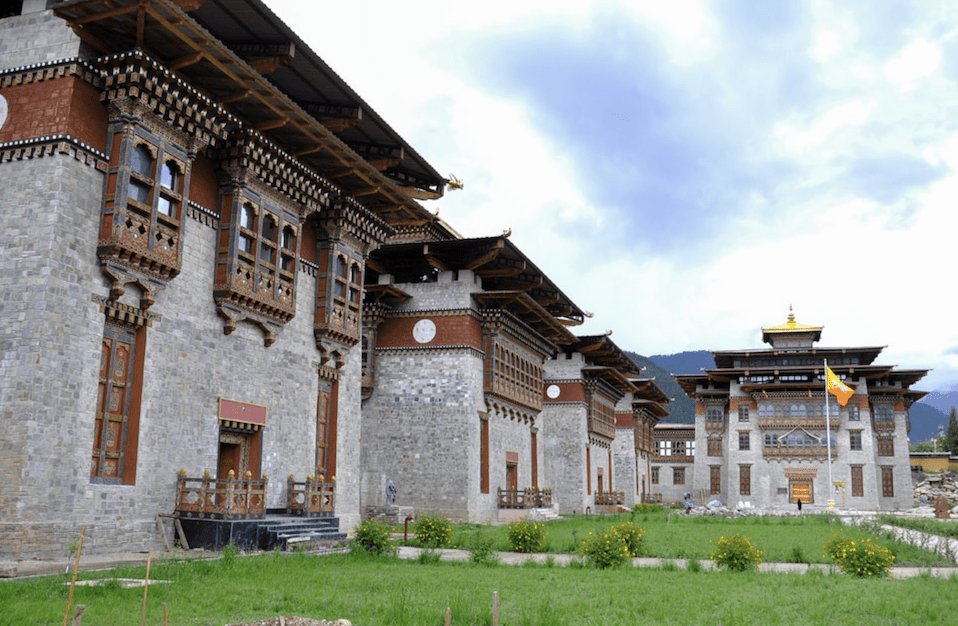
The Nepali version of Buddhism is penetrating in Bhutan in an apparent effort of the Bhutanese government to tighten the grip on the Hindus and to ward off the growing influence of Vishwa Hindu Federation. On 12 June 2019, a chaitya resembling Swayambhunath of Kathmandu valley was inaugurated in Damphu which is a heart of the Hindu culture and civilization in Bhutan. Hindu religion which is also linked to the Nepali language in Bhutan was for a couple of decades symbolised an anti-current entity of Drukpa-Buddhist bravado. His Holiness Je Khenpo Jigme Choedra, the head of the Buddhism in Bhutan, inaugurated the monastery. It was attended by the officers and people of Chirang district. In Bhutan, there has been a constant state pressure on minority Hindus to adopt Buddhism. The first session of the national assembly of Bhutan in 1953 had resolved to convert all the Bhutanese people who spoke Nepali and followed Hinduism into Dzongkha speaking and Buddhism following citizens. The states’ continuous effort led to an expulsion of unmalleable citizens into exile, in the 1990s. Thereafter the remaining Bhutanese population took up the Dzongkha language and soon became more proficient than the native speakers. The imposition of religion was not that easy. Decades of exercises, rules, policies, and lures to metamorphose the Hindus to Buddhists failed. The people rather resorted to Christianity for freedom of worship. No church exists in Bhutan. The constitution does not allow the acceptance of a religion that was not in practice in the country for the last fifty years. Christianity falls in that category. The number of Christian converts has grown tremendously. In the International Nepali Speaking Christian Pastors’ Conference held in Kathmandu last March, at least one hundred Bhutanese pastors were present. It was mentioned in the program that there are fifty to sixty thousand Jesus worshipers in Bhutan. They have no Church but there are no legal hassles congregating in private…