Critical Appreciation – Constructive Criticism

ABSTRACT  What was the need of the Orange Army with strength more than that of the Royal Bhutan Army or the Royal Bhutan Police? The Orange Army called De-Suung (Organisation) and Desuup (members) established in 2010 on the auspicious of the King’s thirtieth birthday is now the largest force in the country with more than 18,000 permanent members from all walks of life and all corners of the country. Formed on the principle of volunteerism, the Orange Army is dedicated to crowd control, rescue and operation during emergencies, takes up the role of alert citizens. Now, it is the fastest-growing organisation in the country. Its formation and functioning are outside the expectation of the constitution. However, the King who is the guardian of the constitution and the supreme commander in chief of armed forces and militia is also the supreme commander of this extra-constitutional Orange Army. While the King needs a recommendation from the Prime Minister to command the army and police, the government has no control over the Orange Army, formed and run by the King who commands it directly. The Orange Army is now running a parallel government and is growing incredibly popular among the citizens most of whom are not happy with the democratic parliamentary system in the country and victims of calamities. There is no mechanism to check the cankerous Orange Army if it walks the way of SAVAK, Gestapo, Ku Klux Klan, or the Yakuza except the formation of another extra-constitutional institution to counter it.   Keywords: calamities, secret agency, totalitarian, volunteerism, militia, security  Read Complete Article

Professor Dr. Michael Hutt, who was until recently Professor of Nepali and Himalayan Studies, at the School of Oriental and Africa Studies (SOAS), University of London, is a renowned scholar on Bhutan studies. He has visited Bhutan, the Bhutanese refugee camps in Nepal, and Bhutanese resettled in developed countries. He has closely studied the refugee saga from the beginning till date. He has authored books and articles in peer-reviewed journals on Bhutanese issues. I P Adhikari and Dr. Govinda Rizal of Bhutan Watch Team approached Dr. Hutt for a conversation on past, present and future of the former and current Bhutanese refugees.  Read Complete Interview

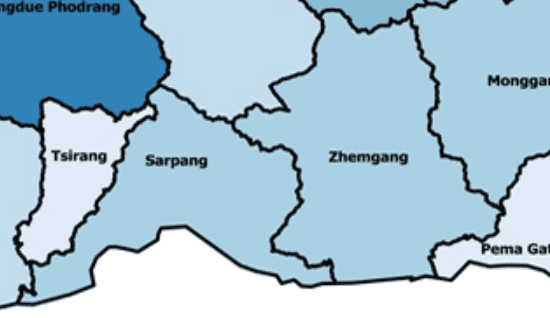
Sarpang and Zhemgang districts have become the hotspot of political wrangling in Bhutan for over a month. The iron is still hot and none of the parties are willing to back off from their allegations against the other. The race is unlikely to settle soon, if no royal intervention made. However, royal intervention will be unconstitutional though softer approach is not unanticipated. Cause The battle begun with government’s decision to remove Zhemgang district from national tourism flagship programme and replace it with Sarpang. The government proposal passed the parliament for Nu 200 million worth of tourism programmes for the fiscal year 2019-20 out of the Nu 1 billion in the 12th Plan where Zhemgang was supposed to be the beneficiary, not Sarpang. The idea to include southern district in the flagship programme and open southern doors for tourists was initially presented by the opposition party – Druk Phuensum Tshogpa (DPT). The government resisted the idea saying Bhutan does not have appropriate and adequate infrastructure for border security to run such programme. Upon opposition’s pressure, government agreed to open entry points in southern districts. Initially government proposed for Dagana, Gasa, Lhuentse and Zhemgang.  The districts were means to have regional balance. Dagana representing southern region, Gasa the western, Lhuentse the central and Zhemgang eastern region. With Zhemgang being replaced by Sarpang, the eastern region has now been left out with the programme. Allegations Opposition party DPT alleged that government deprived the district of national programme because the district voters did not choose Druk Nyamrup Tshogpa (DNT) in last election. Zhemgang’s both representatives in the National Assembly are from the opposition party – DPT. The Opposition approached the Speaker of National Assembly to revoke the government decision. However, speaker opined that government has the authority to make changes in the budget appropriation and alter programmes as needed. The Office of Attorney General – the legal advisor to the government – also favoured government’s…

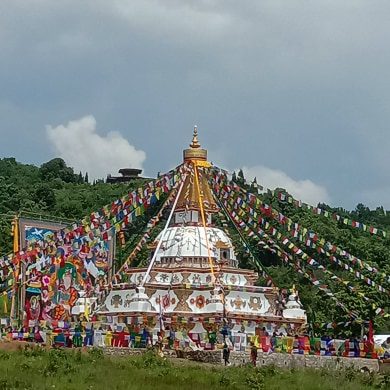
The Nepali version of Buddhism is penetrating in Bhutan in an apparent effort of the Bhutanese government to tighten the grip on the Hindus and to ward off the growing influence of Vishwa Hindu Federation. On 12 June 2019, a chaitya resembling Swayambhunath of Kathmandu valley was inaugurated in Damphu which is a heart of the Hindu culture and civilization in Bhutan. Hindu religion which is also linked to the Nepali language in Bhutan was for a couple of decades symbolised an anti-current entity of Drukpa-Buddhist bravado. His Holiness Je Khenpo Jigme Choedra, the head of the Buddhism in Bhutan, inaugurated the monastery. It was attended by the officers and people of Chirang district. In Bhutan, there has been a constant state pressure on minority Hindus to adopt Buddhism. The first session of the national assembly of Bhutan in 1953 had resolved to convert all the Bhutanese people who spoke Nepali and followed Hinduism into Dzongkha speaking and Buddhism following citizens. The states’ continuous effort led to an expulsion of unmalleable citizens into exile, in the 1990s. Thereafter the remaining Bhutanese population took up the Dzongkha language and soon became more proficient than the native speakers. The imposition of religion was not that easy. Decades of exercises, rules, policies, and lures to metamorphose the Hindus to Buddhists failed. The people rather resorted to Christianity for freedom of worship. No church exists in Bhutan. The constitution does not allow the acceptance of a religion that was not in practice in the country for the last fifty years. Christianity falls in that category. The number of Christian converts has grown tremendously. In the International Nepali Speaking Christian Pastors’ Conference held in Kathmandu last March, at least one hundred Bhutanese pastors were present. It was mentioned in the program that there are fifty to sixty thousand Jesus worshipers in Bhutan. They have no Church but there are no legal hassles congregating in private…