Over the past decade, Bhutan has experienced a marked rise in lifestyle-related health problems as traditional patterns of living give way to modern habits. This paper examines emerging non-communicable diseases and risk factors in Bhutan from ~2015–2025, drawing on government data, surveys, and academic studies. It reviews Bhutan’s traditional active, agrarian lifestyle and diet, then detail how rapid socio-economic development has altered lifestyles. Sedentary behaviour, processed diets, and other changes have led to increasing obesity, diabetes, and cardiovascular diseases. The causes of these shifts – urbanisation, globalisation, and changing socio-cultural norms – are explored. The paper analyses the geographical distribution of lifestyle diseases and the age groups affected. Health expenditure trends are reviewed, showing growing government spending on non-communicable disease prevention and treatment. Read Full

Gelephu sits on widest flat land of the country yet Bhutan’s mountain terrain mean the uneven geography is the challenge for any infrastructure development that are necessary for a thriving commercial hub. Bhutan’s commitments to ecology conservation is internationally recognised. On top of that GMC requires enormous investments to build infrastructure in the terrain, for which the country lack adequate capital. Under such circumstances, GMC leadership’s task requires fine tuned marketing skills to win the trust of investors that GMC guarantees return on investments. Read full
The proposed Gelephu Mindfulness City (GMC) represents a transformative urban development initiative in Bhutan, aimed at establishing a pivotal business connection between South East Asia and South Asia. Announced by King Jigme Khesar on December 17, 2023, the GMC aspires to create a holistic living environment attuned to Bhutan’s philosophy of Gross National Happiness (GNH), emphasising mindfulness, sustainability, and community well-being. This article explores the vision, strategic location, design principles, stakeholder collaborations, socio-environmental considerations, and potential challenges associated with the GMC. Read Full
This research attempts to explore secular aesthetics reflected in Punarwaspachhika Bhutani Nepali Kavita (Post-Resettlement Bhutanese Nepali Poems), an anthology of Nepali poems representing post-resettlement Bhutanese-Nepali literature published by Nepal Academy in 2022. Religion is still a dominant aspect of the everyday politico-cultural life. It has been more than three decades the people of Bhutan were evicted and made refugees. Majority of those are now resettled in the Global North countries. Their call for human rights, equality and democracy echoed from exile since 1990. But finding secular aesthetics in Bhutanese-Nepali literature is very rare. This qualitative research primarily explores secular aesthetics in the post-resettlement Bhutanese Nepali representative poems. The anthology Punarwaspachhika Bhutani Nepali Kavita has been assessed from the notion of hegemony and counter-hegemony. And this research analyses historicity of the selected post-resettlement Bhutanese Nepali poems with an aim how this text exists (or fails to act) in the counter-hegemonic actions. Read in full
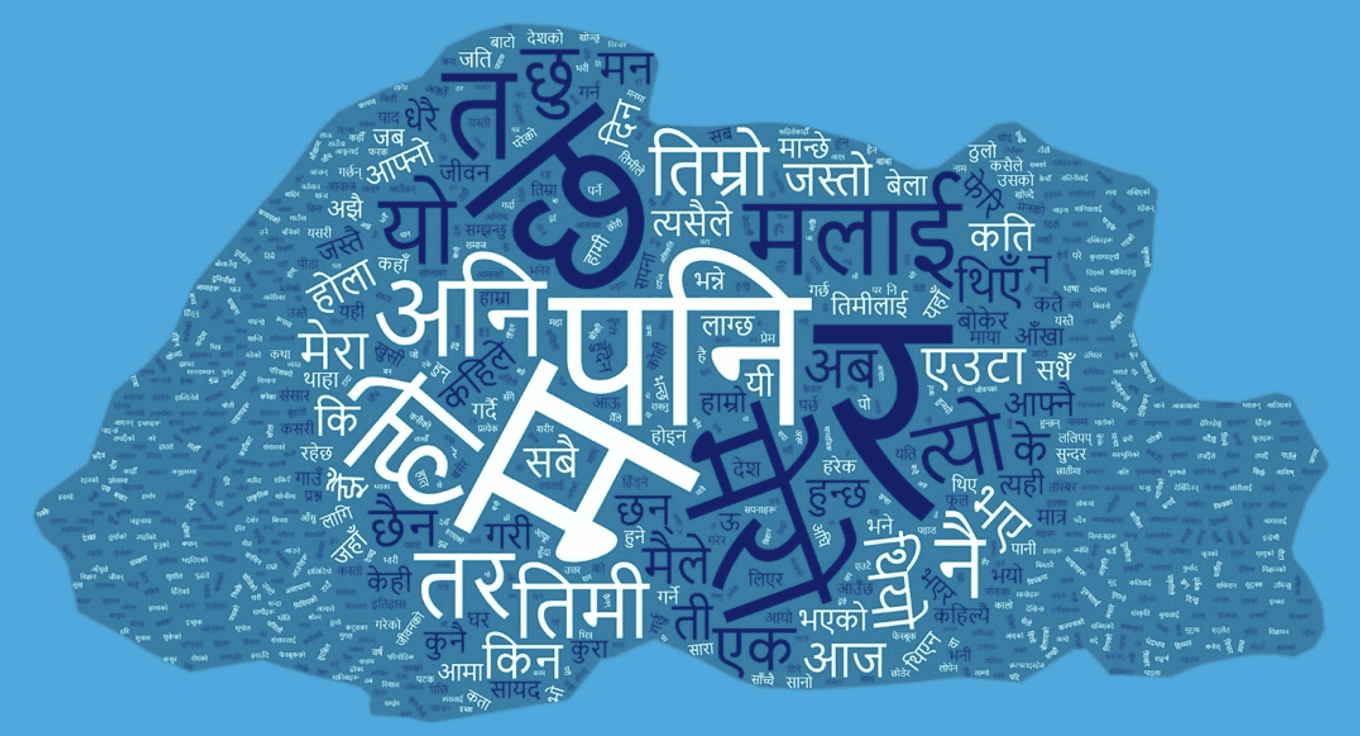
Interpretation of poetry is generally based on qualitative analysis of semantics, figurative language and expression, and knowledge about the author and literary elements. Recent advancements in computer-based text processing allow us to analyse a large amount of text quantitatively. In this study, we analyse 135 poems published in the anthology ‘Post-resettlement Bhutanese Poetry’ quantitatively using natural language processing (NLP) techniques. We analyse and interpret the words and word patterns in the anthology, classify each poem based on codes for word-use and combine assigned codes into broader themes. NLP in the Nepali language is not developed enough to classify every poem into meaningful categories; however, it can help extract meaningful insights on word-use and themes even in a complicated literary text that would not have been possible using a qualitative approach. NLP was instrumental in breaking down a large amount of text into words and subsequently categorizing the words into codes, sub-themes, and themes for further analysis. This paper presents two useful aspects of literary analysis. Firstly, it interprets the social, cultural, and contemporary aspects of Bhutanese people’s lives after resettlement represented through poetry. Secondly, it presents NLP as a methodological technique in analysing literary texts written in the Nepali language. Read in full
Much has been studied and written on Gross National Happiness (GNH) and Bhutanese Refugee Issue in the past decades, but scholars and researchers are yet to write on the issue of statelessness among the former Bhutanese Citizens. In this article, I have attempted to study and analyze this issue to find the root cause of Bhutanese Citizens becoming stateless in their own country and in the diaspora. An attempt has been made to find the suitable answer of how a country that propagates the philosophy of happiness could revoke the citizenship of its people and escape from crime. This paper mainly focuses on the issue of statelessness among the former Bhutanese Refugees in their country of resettlement and studies the activities of respective community organizations to make the issue public for its resolution. The phenomenological approach was followed to write this article. Read full
Citizenship of a state is the right of the holder to have the same rights as any other member of the state. In contrast, categorization of citizenship creates distinct groups with different limitations, rights, and privileges and makes citizens unequal before the law. In Bhutan, there are three major and seven subcategories of citizens created by the government. The three major categories include ‘natural-born citizen of Bhutan,’ ‘Bhutanese citizen by registration,’ and ‘naturalized citizen of Bhutan.’ Based on marriage and presence or absence during regular and surprise censuses, there are seven sub-categories of citizens ranked F1 to F7, the abbreviations of the files (F) in which their names are listed. Marriage laws of Bhutan discourage marriages between a Bhutanese citizen and a non-Bhutanese spouse through lifelong penalties and demotion in citizenship categories. While both polyandry and polygamy are legal for up to four marriages, the encouragement is on intra-category marriages. The marriage law applies even to the crown prince, who is a successor of the throne, that he must marry only ‘natural-born citizen of Bhutan’ to remain eligible to the throne. This article highlights the background of promulgation of citizenship and marriage laws and their implication, so that future researchers can compare the Bhutanese and international laws and study how the outlook of the people are shaped. Read full
Gender violence is an old problem worldwide. It is not an exception in the Bhutanese Community. However, the severity of the problem has grown substantially within the Bhutanese American Community following resettlement. In most cases, the victims are women and girls. A deeper investigation and historical authenticity might require finding the cause – whether the problem has grown following resettlement, or it was subdued while living in exile. This research was aimed to dig out the causes of growing gender violence in a newly resettled community and seek solutions to the problem. An anonymous survey was conducted, and the author held a conversation with a number of community members and victims. Educating the victims to speak against their perpetrators while still providing social and other support would change the way the newly established community prosper. Dedicated service and support are required from local law enforcement agencies to encourage them to tell their stories. They need easy access to and guarantee of privacy and security from the police department, sexual assault hotline, medical practitioners, school and community organisations. Read Full
A Bhutanese guard frisks voters at a polling station in Phuentisiling constituency, some 45 Kms from the Indo-Bhutan border, 31 December 2007. The isolated Himalayan kingdom of Bhutan held its first parliamentary elections aimed at transforming the country from absolute monarchy to constitutional democracy. "Polling has begun in 15 districts with the response quite enthusiastic. This is a historic moment for all of us," Bhutan's chief election commissioner, Dasho Kunzang Wangdi, said by telephone from the capital Thimphu. AFP PHOTO/Diptendu DUTTA (Photo credit should read DIPTENDU DUTTA/AFP/Getty Images)
ABSTRACT Bhutan is now a democracy. This new democracy promotes adult franchise. It conducts periodic elections and has elected members in parliament and government. It has political parties contesting elections. Despite these basics of democracy, the country lacks accountability mechanisms, participatory channels, independent and active civil societies, education about democracy, and a monitoring system that are central to a functional democracy. Citizen-government continues to remain concerning factors in institutionalising democracy in Bhutan. Drawing from regional experiences, Bhutan poised to have a bumpy ride on democracy. The issue of human rights and social justice would be a far cry. This paper discusses the parameters of democracy and public participation in Bhutan and the future of Bhutanese democracy. Keywords: Democracy, election, participation, people, political parties, adult franchise, human rights Read Complete Article
ABSTRACT The Bhutanese Refugee Cultural Complex (BRCC), housed in Jhapa in eastern Nepal, is a centre devoted to the memory and study of Bhutanese refugees. As the BRCC develops into a fully functioning centre, it is worth asking about its purpose(s). Building on research conducted on other memorialisation initiatives, in this article I suggest five possible purposes for what I called commemorative structures: documenting history; preventing future problem events; reconciliation; individual healing; and tourism. I analyse the potential for the BRCC to fulfill these roles, and suggest the questions that might need to be answered to make this a reality. Keywords: Bhutanese refugees, history, memory, memorialization, persecution, reconciliation, culture Read Complete Article